Contact Info
-
Sheng'an Building, No. 296 Xinhua Road, Shijiazhuang, Hebei Province
1. The energy management system is a necessary pathway to further optimize energy utilization.
The traditional energy management model relies heavily on manual involvement in measurement, aggregation, statistics, and analysis, making accuracy, timeliness, and reliability difficult to guarantee. Companies often lack awareness of their energy consumption, with questions like "How much is being used? Is consumption normal? How can it be optimized?" becoming prominent.
The energy management system integrates energy control and management with production scheduling, enabling companies to "understand, manage, and reduce" energy consumption, ultimately achieving the goals of safety, stability, economic balance, energy conservation, emission reduction, and environmental quality.
2. Shifting energy management from "post-event statistics" to "preemptive intervention."
The traditional energy management approach focuses on post-event statistics, lacking the ability to actively intervene in real-time energy consumption, which does not align with the needs of refined management.
Informatization makes it possible to combine data analysis with trend prediction, facilitating the shift from "post-event statistics" to "preemptive intervention."
3. Providing more basis for technical reforms from an energy consumption perspective.
As energy data becomes more visual, timely, and accurate, its significance in guiding technical reforms will grow, helping companies invest in advanced energy control measures.
4. Effectively enhancing the company's energy management capabilities.
Headquarters' energy statistical analysis often relies on manually reported data from production plants, which lacks accuracy and cannot be verified. Meanwhile, methods like energy consumption benchmarking and efficiency indicator comparisons are outdated, failing to provide effective feedback or optimization for overall energy usage.
By building a dual-layer energy management informatization system, the company can more promptly and accurately monitor the energy usage and anomalies of its production plants, facilitating further improvements in overall energy management through comparative analysis.
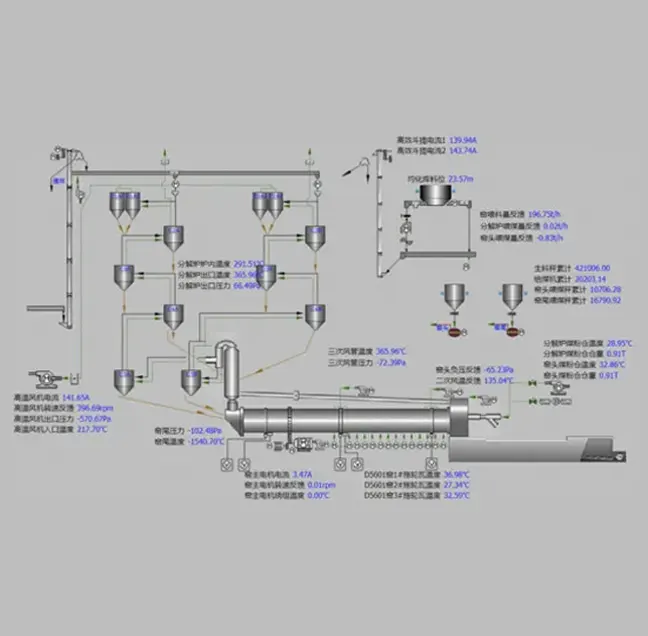
Data Collection: DCS production data, power monitoring data, compressed air usage data, water consumption data, oil consumption data, logistics data, and quality inspection data
Intelligent: production monitoring, energy consumption monitoring, energy consumption analysis, benefit analysis, environmental monitoring, quality management, reporting systems, performance systems, system management, and mobile app functionalities